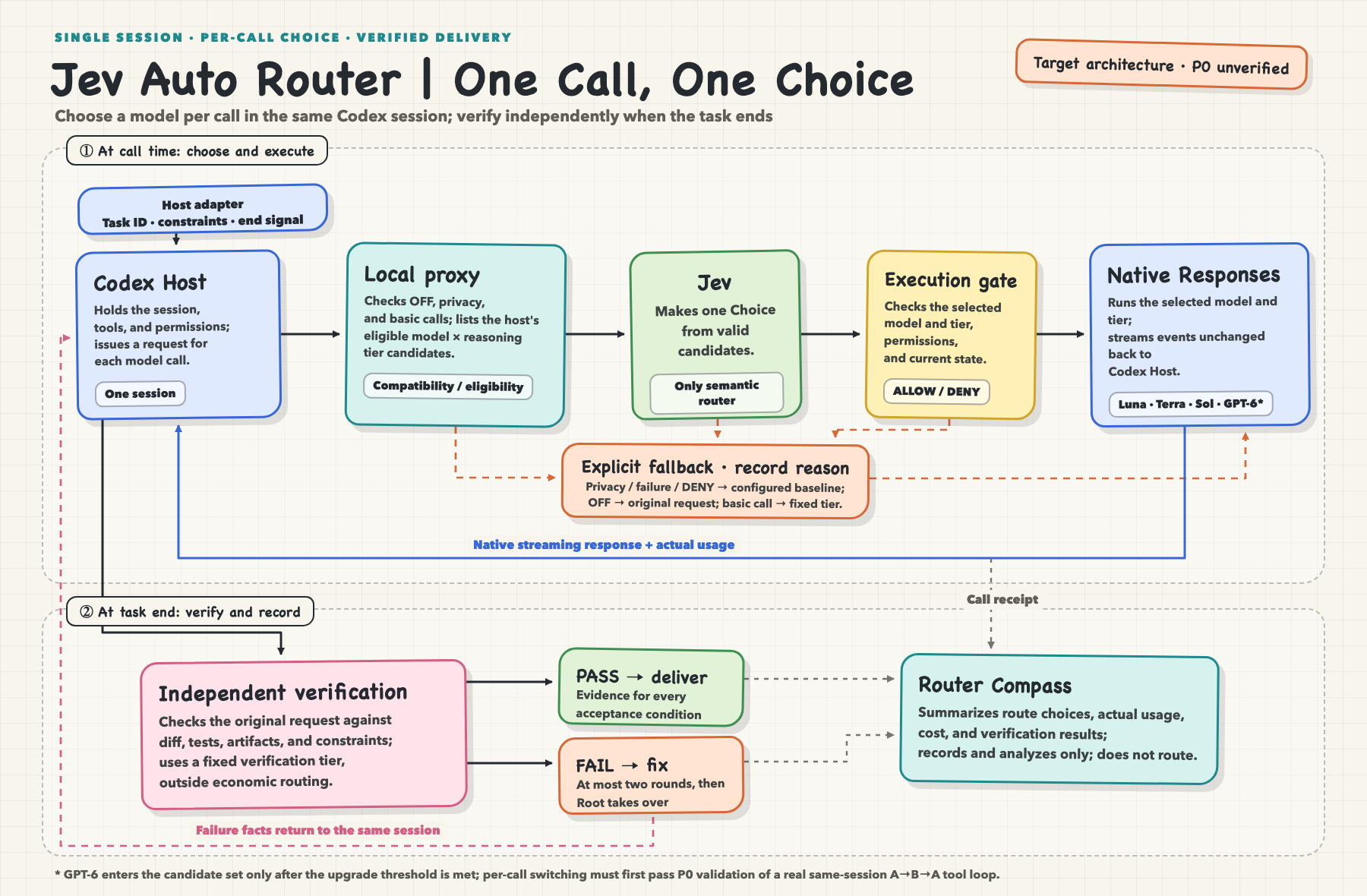
Jev Auto Router is an experimental Codex model
router. TypeSafe's Jev makes one typed
Choice over host-supported (model, reasoning effort) pairs. A local Responses
proxy keeps the Codex session and tool loop continuous while the route can change call by call.
Architecture is approved; runtime is a validation prototype. Cross-model switching in a real Codex tool loop, the complete verification path, and savings have not been proven end to end. This guide explains the design and prerequisites — not an install-and-auto-route promise.
What you need
- A TypeSafe account and Jev API key (
JEV_API_KEY; can matchTYPESAFE_API_KEY). - Node.js 22+ and a signed-in Codex CLI.
- Access to the model and reasoning-effort pairs you want to route on the host.
A Jev key alone does not make live per-call routing available.
What happens on each call
- Local Responses proxy receives the call, checks whether routing is off or the call is infrastructure-only, and builds only pairs the host can request.
- Jev Choice selects model and effort together. Ordinary candidates are Luna Max, Terra, and Sol. GPT-6 is ineligible by default.
- Execution guard validates ALLOW or DENY. It does not re-pick a different plan. Timeout, low confidence, or invalid answers fall back to Terra/medium with a recorded reason.
- Native Responses executes with the Codex session and tool loop intact. Logs record the actual model, effort, usage, and fallback reason.
What this is not
- Not a second semantic router or task-kind table that overrides Jev.
- Not automatic GPT-6 escalation after Sol struggles.
- Not a claim that routing already saves money in production.
Local development commands
These validate current prototype code; they do not connect Codex to a production proxy:
npm ci
npm test
npm run typecheck