Jev selects model and effort together over host-supported pairs. Local code adds no task-kind table or second semantic router.
Why per call
Hard reasoning and routine follow-ups do not need the same model.
The local Responses proxy preserves session continuity and the tool loop while the route can change call by call.
Task completion is checked against the original request. The executing model's claim of success is not evidence.
Architecture
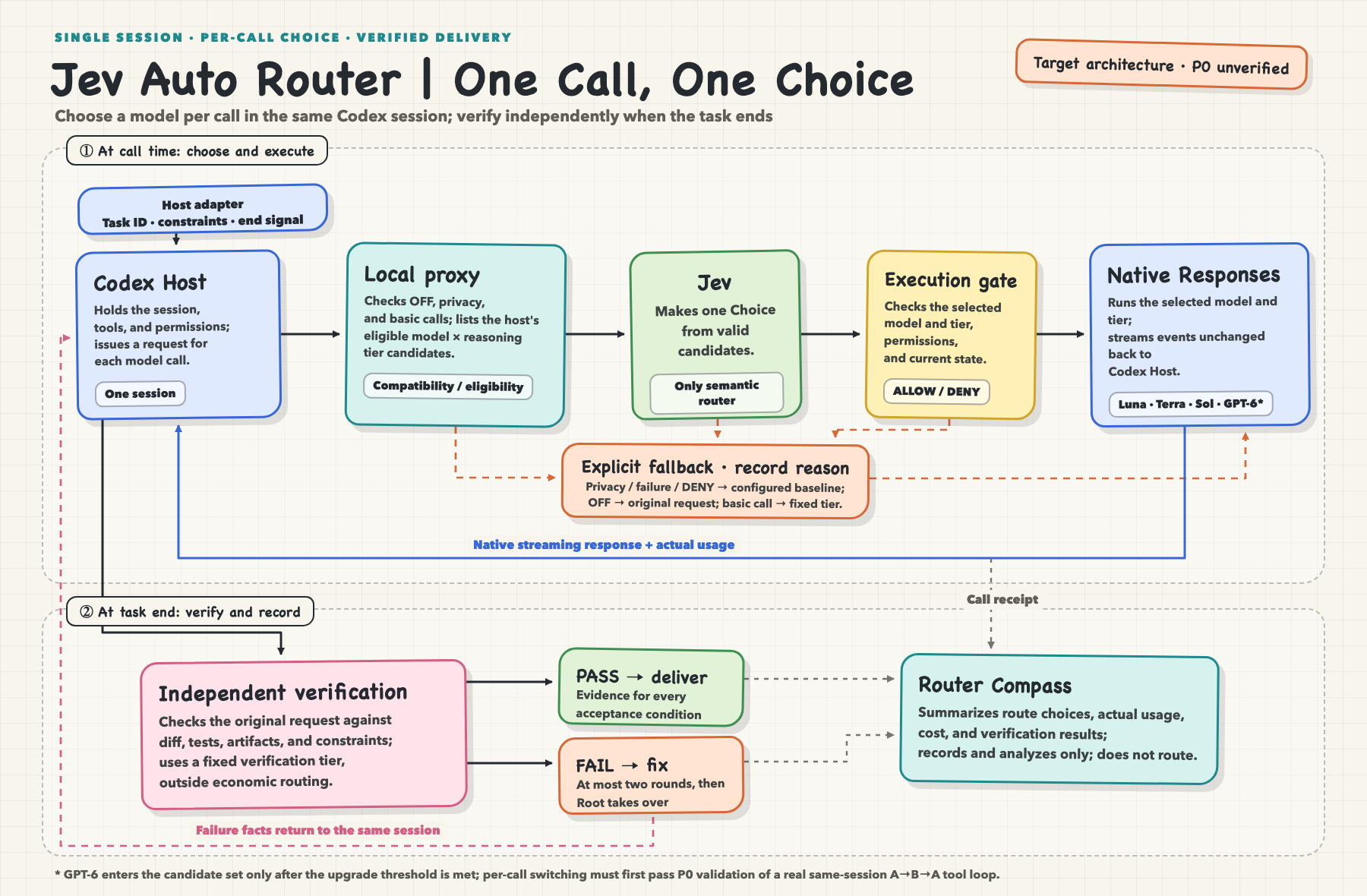
Codex call → local proxy → Jev Choice → Responses → task verification.
The proxy builds only the `(model, reasoning effort)` pairs the host can actually request. Jev makes one Choice. An execution guard validates ALLOW or DENY. Native Responses keeps streaming, tool IDs, and continuation intact. After the task, verification and Router Compass connect route choices to real usage and acceptance.
Capability tiers
Four tiers. GPT-6 stays scarce by default.
| Tier | Typical role | Ordinary calls |
|---|---|---|
| Luna Max | Explicit, mechanical follow-up steps | Eligible |
| Terra | Everyday work and the fallback baseline | Eligible |
| Sol | Harder reasoning, implementation, and correction | Eligible |
| GPT-6 | Scarce escalation supported by evidence | Ineligible by default |
- Fallback default is Terra/medium with a recorded reason.
- Turning the router off restores the host's original model.
- Tier names must match pairs the host actually supports.
Needs
What you need before any live routing experiment.
The proxy reads JEV_API_KEY. TypeSafe examples use
TYPESAFE_API_KEY; both can hold the same key. Never commit secrets.
Node.js 22+, a signed-in Codex CLI, and access to the model and reasoning-effort pairs you want to route. A Jev key alone is not enough.
Guides
Search-oriented how-tos for Codex model routing.
Short technical pages for the queries people actually search: per-call routing, verification, and a Chinese-language walkthrough of the same design.
Why per-call routing exists, what Jev chooses, and what the local proxy preserves.
Read the guideIndependent acceptance, Router Compass evidence, and why savings are not assumed.
Read the guide面向中文社区讲清逐调用架构、前置条件和当前原型边界。
阅读指南Browse the full collection from one index page.
Open guides hubTry the source
Prototype code is open. Production routing is not claimed yet.
Local development validates the current proxy, routing decisions, verification, and
Compass structures with npm ci, npm test, and
npm run typecheck. Those commands do not connect Codex to a production
proxy. License: Apache-2.0.