Claude Code reads CLAUDE.md and ~/.claude.json. Cursor uses
AGENTS.md, ~/.cursor/mcp.json, and its own commands or skills
directory. Once both tools have real config, drift starts fast: rules diverge, MCP lists
split apart, and the safest-looking shortcut is often the one most likely to overwrite
native state.
Why this pairing drifts so easily
- Claude Code and Cursor do not store instructions in the same file name.
- Their MCP files are shaped differently and are not equally safe to replace.
- Useful commands and skills live in separate directories.
- Claude Code's native config can include state you do not want to clobber just to sync one MCP server.
The hard part is keeping Claude Code and Cursor aligned after day two, when both tools already have native state that should survive the sync.
A safer model for Claude Code and Cursor
In practice, the safer model is one local source of truth plus per-tool writes that respect each tool's native format:
- one baseline for shared rules
- one canonical MCP server list
- one shared store for reusable skills or commands
- backups before every native write
- partial writes where the native file also holds tool-owned state
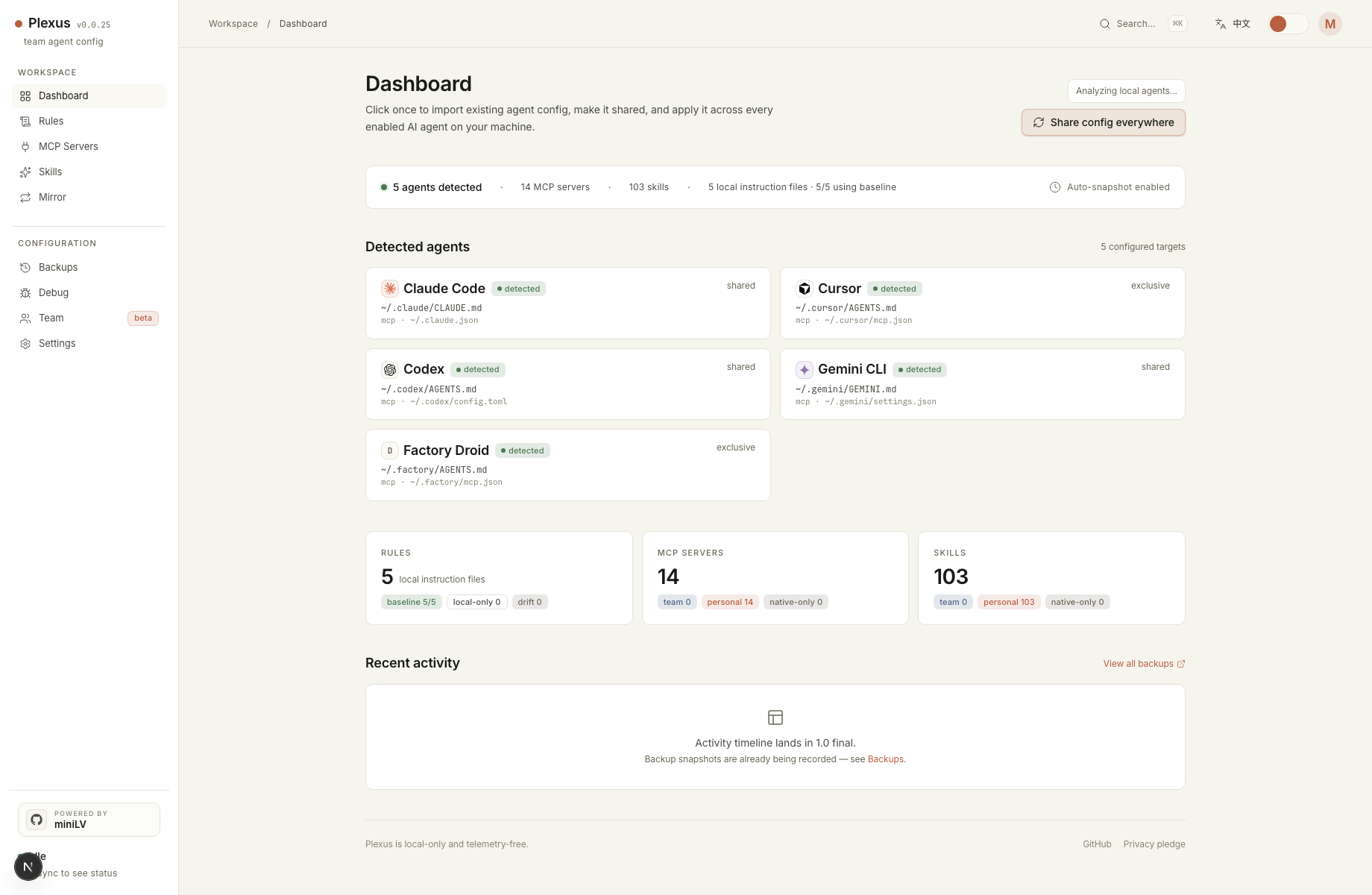
That is the model Plexus uses. It imports the config already on your machine, stores the
canonical copy under ~/.config/plexus/, then projects rules, MCP servers,
and skills back into Claude Code and Cursor in their own expected shapes.
What Plexus preserves
- It does not run MCP servers.
- It snapshots native files before writes.
- It partial-writes shared files instead of replacing them wholesale.
- It keeps the canonical store local and telemetry-free.
Why this matters specifically for Cursor
Cursor is often the editor you touch most frequently, so small config mismatches become visible quickly. A good sync model needs to keep Cursor convenient without turning Claude Code into a second copy you have to remember to patch later.
Quick start
npx -y plexus-agent-config@latest startOpen the local dashboard, import the agents already on your machine, preview the merge, and sync the resulting rules, MCP servers, and skills back into Claude Code and Cursor.
When this is a better fit than dotfiles
Dotfiles work well when every target file is fully yours. Plexus is aimed at the more awkward case: different tools, different native formats, and at least one shared file that should not be replaced just to keep configs aligned.